Who pays and who receives in Mexico, by age?
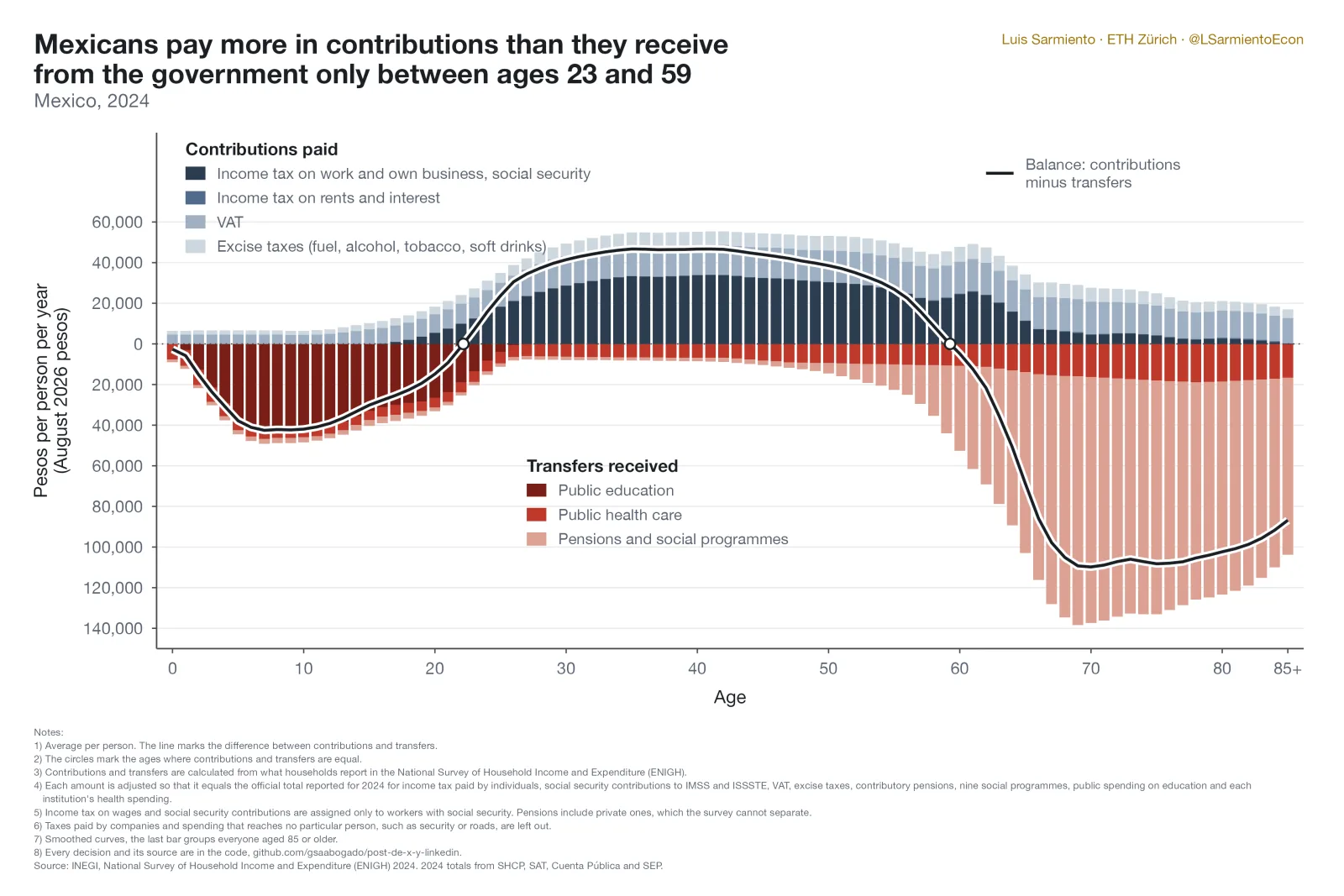
Mexicans pay more in contributions than they receive from the government only between ages 23 and 59. A simple illustrative exercise shows why births matter so much for public finances.
Code on GitHubHow much does an average person in Mexico pay in contributions, and how much does that person receive from the government, at each age? I calculated it with the 2024 household income and spending survey (ENIGH) and the public accounts. Only between ages 23 and 59 do people pay more than they receive. In pesos of August 2026, the balance peaks at 46,722 pesos a year at age 35 (about US$2,740) and falls to minus 109,796 pesos at age 70 (about US$6,440).
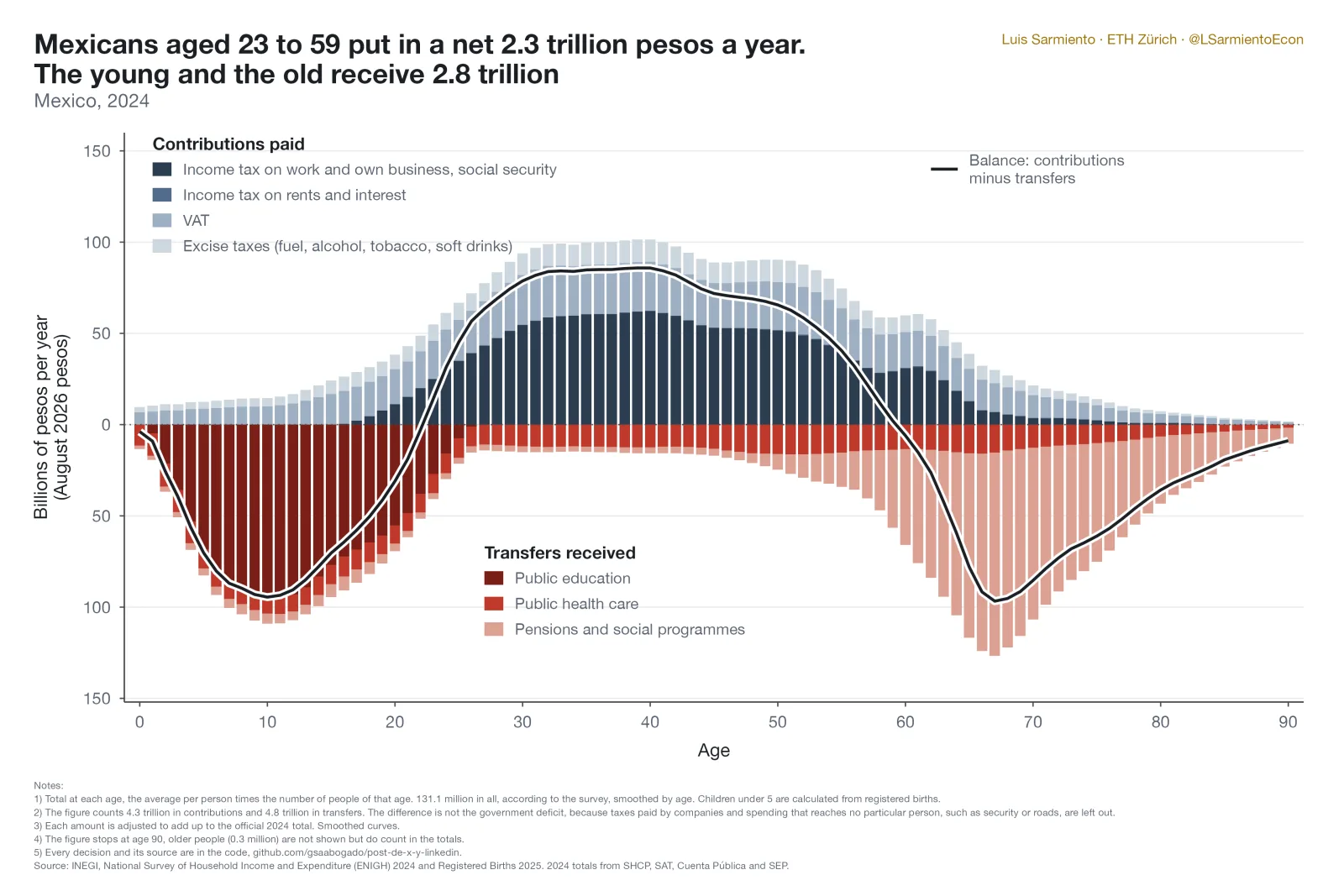
The number of people at each age matters more for the budget. Those aged 23 to 59 put in a net 2.3 trillion pesos a year (US$137 billion). The young and the old receive 2.8 trillion (US$165 billion).
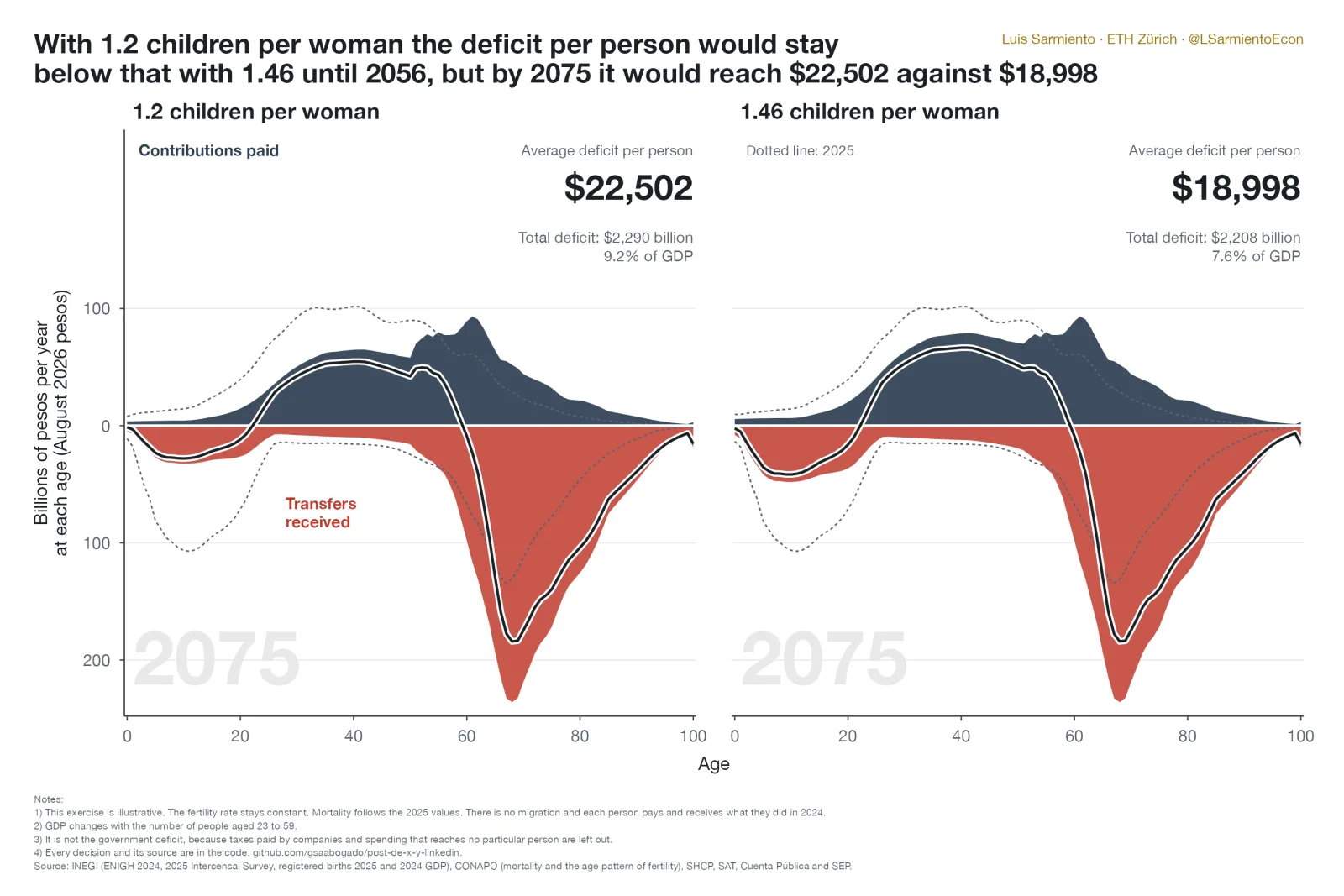
What would happen to these figures if fertility stayed at 1.2 or 1.46 children per woman until 2075? In a simple illustrative exercise, the gap between what people pay and what they receive would go from 1.4% of GDP today to between 7.6% and 9.2%. While this is not a precise forecast, it shows why births matter so much for public finances.
The last chart follows the deficit per person in both scenarios. With fewer children it would be lower until 2056, with less school to pay for. From 2048 workers would be missing, and by 2075 it would reach 22,502 pesos against 18,998 (about US$1,320 against US$1,110).
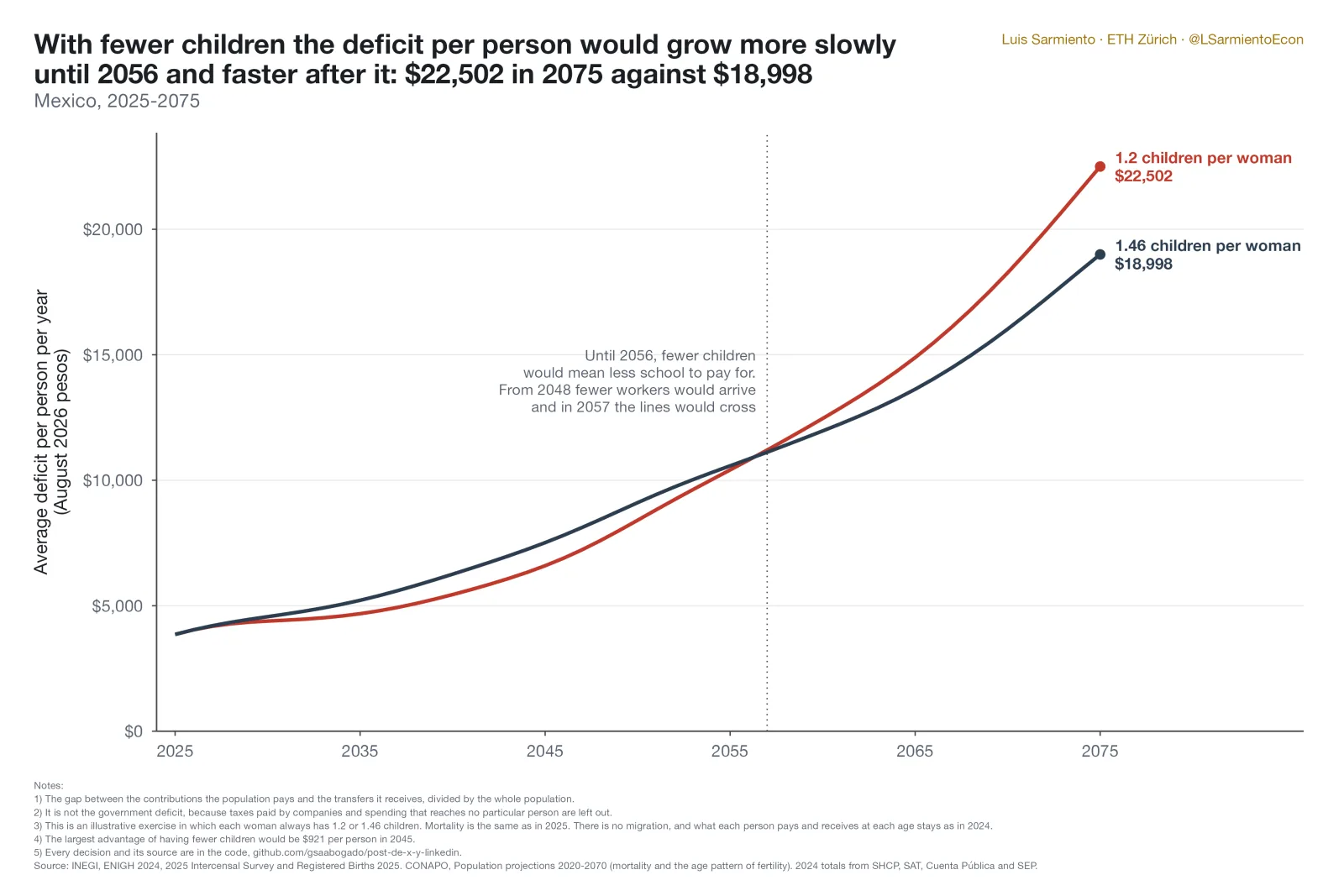
Note that this exercise does not identify the government deficit per se, because taxes paid by companies and spending that reaches no particular person are left out.
Sources: INEGI, ENIGH 2024, Encuesta Intercensal 2025 y Estadística de Nacimientos Registrados 2025. CONAPO, Proyecciones de la población 2020-2070. SHCP, SAT, Cuenta Pública y SEP. FRED.